I gave this talk at AWS Community Day DMV 2026 at Amazon HQ2 on October 2, 2026. This is the recap.
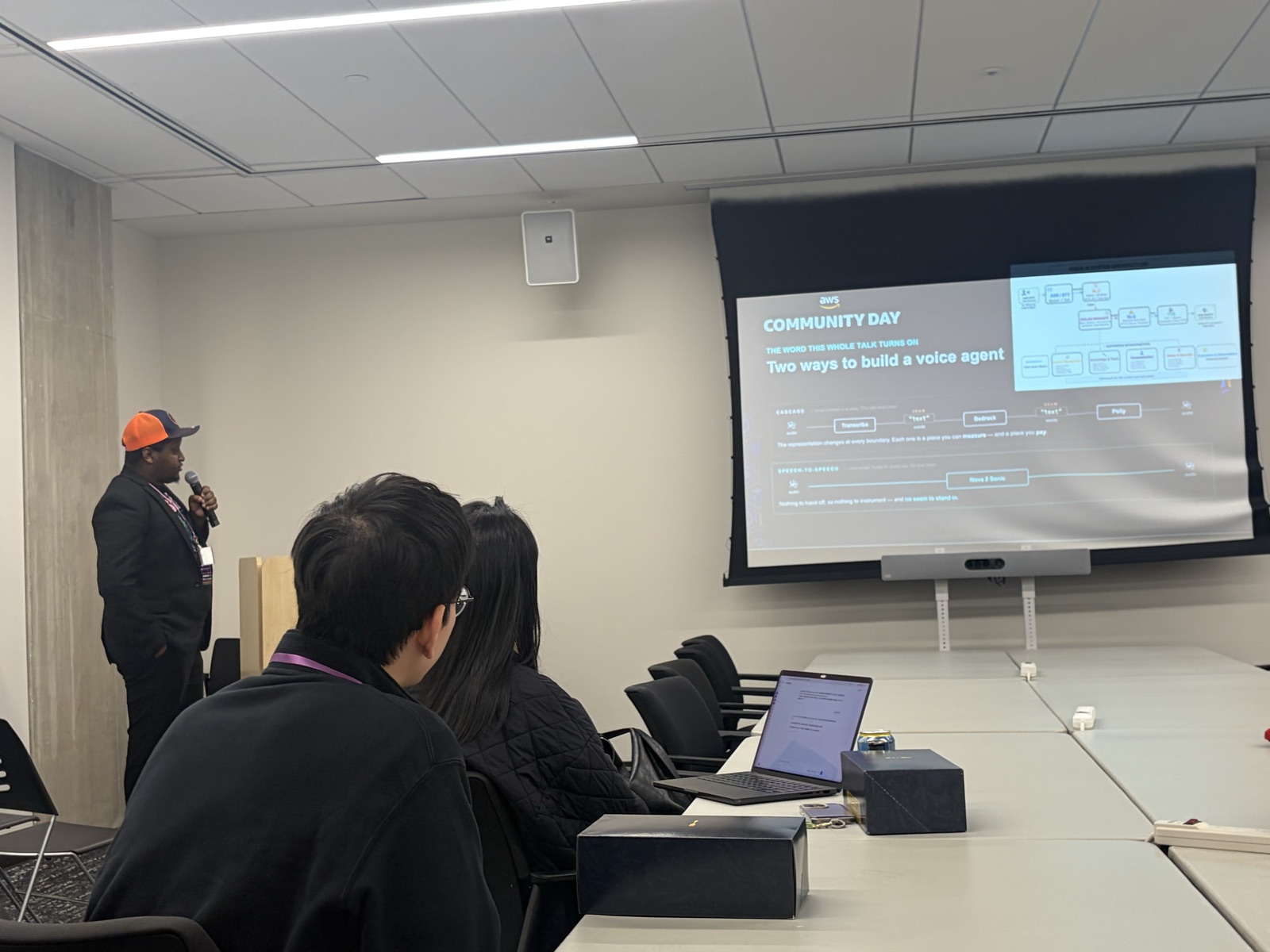
Presenting “Two ways to build a voice agent”, cascade vs speech-to-speech, at Amazon HQ2.
The talk opened with one sentence: these lessons came from an agent that took real phone calls. I rebuilt it on AWS for the talk, one WebSocket, one Fargate task, and measured everything instead of estimating it.
The scenario
Airline rebooking. One caller, one recording, airport ambience in the background. The caller says three things:
- “My flight to Baltimore just got cancelled. The six-forty.”
- “Confirmation K as in kilo, seven, R, two, nine, X.”
- “And I had a checked bag on the original.”
Four slots to fill. One of them is hard.
Watch it fail
Same audio, same commit, three runs, four booleans. Run A is the naive build: it cuts the caller off, guesses, and answers itself. Run B is the shipped build: fixed, but it cannot be interrupted. Run D is the 2026 build: correct, and 736 ms faster.
Three runs is the whole method. If you cannot replay the same audio against different builds and compare the numbers, you are guessing.
The confidence gate: ask, or guess?
On one take, Transcribe returned “…confirmation is K 7 or 29 X.” with a confidence of 0.33. With the gate off, the agent writes K7OR29X into the booking. No flag, no warning. The wrong passenger flies.
With the gate on at 0.75, the agent refuses to write it. It records the slot as flagged and asks the caller: “K-7-O-R-2-9-X, correct?”
The gate costs one extra turn every time it fires. That is the trade, stated plainly: one turn against a wrong booking reference.
The echo guard: the fix that shipped a walkie-talkie
The caller said five things. Run B heard two:
- “…my flight to Baltimore just got cancelled.” (heard)
- “I need to get there tonight, or tomorrow morning.” (deaf)
- “No, wait, tonight, if there’s anything at all.” (deaf)
- “Confirmation K as in kilo, seven, R, two, nine, X.” (heard)
- “And I had a checked bag on the original.” (deaf)
The echo guard stopped the agent from answering itself. It also stopped the caller from being heard for 7.3 seconds a turn. The fix shipped a walkie-talkie: one side talks, the other side waits.
Where the seconds actually go
One turn, measured end to end:
- Endpointer holds: 1500 ms
- Transcribe final: 17 ms
- Bedrock first token: 482 ms
- Lambda lookup: 1851 ms
- Filler audio out: “Let me check…”
- Answer synthesis: 219 ms
- Caller is deaf: 7.3 s unheard
The caller hears something at 1088 ms. The lookup finishes 1.6 s later. That filler is what keeps the call from feeling dead while the lookup runs.
Every fix costs something
Every production fix, with its price tag:
| Fix | What it fixed | What it costs |
|---|---|---|
| Endpointer 700 to 1500 ms | Stopped cutting the caller off | +800 ms, every utterance |
| Confidence gate | Stopped a wrong booking reference | +1 turn, when it fires |
| Echo guard | Stopped the agent answering itself | 7250 ms, cannot interrupt |
| Filler at tool decision | Caller hears something in 1088 ms | -1620 ms, a fix that pays |
| Semantic endpointing | Correct and fast vs the threshold | -736 ms |
Three of those fixes cost you time, a turn, or the ability to interrupt. Two give time back. The point is not which direction, it is that you know the number before you ship.
Instrument what you cannot see
Every number in the talk has a CloudWatch metric name. The rig emits them with CloudWatch EMF straight from a Fargate task: metrics from stdout, no PutMetricData calls.
The rule on that slide: if you cannot see it, you cannot defend it. When someone asks why the agent feels slow, you want a metric name, not an opinion.
Cascade vs speech-to-speech
About 90% of voice agents still ship a cascade: Transcribe to Bedrock to Polly, 482 ms here, 219 ms there. Every seam is a place to measure, and a place to pay.
Nova 2 Sonic is the other option: one bidirectional stream, faster. The 2026 answer is hybrid. Speech-to-speech where latency dominates. Cascade where you need tools.
Three takeaways
- Every fix costs something. The gate adds a turn. The guard costs the ability to interrupt. Ship the fix with the price tag attached.
- Measure the seam, not the guess. Everyone blames text-to-speech. 59% was the model. Find the actual seam before you optimize.
- Read the words, not the silence. A pause mid-sentence and a pause at the end are identical to the endpointer. Your system has to tell them apart.
Dig deeper
From the talk’s resource list, worth your time next: Amazon Nova 2 Sonic on Bedrock (bidirectional streaming), Transcribe item confidence (what the clarification beat needs), and CloudWatch EMF (metrics from stdout, no PutMetricData). The rig itself is Transcribe to Bedrock to Polly on Fargate, with a measurement harness that reproduces every number, and my notes on what broke, including the fix that only looked fixed.